canon rebel xt camera manual
Canon’s Rebel XT, also known as the 350D, gained popularity due to accessible digital SLR photography. Numerous guides and manuals,
including those available online and in book form, assist users in mastering its features.
What is the Canon Rebel XT?
The Canon Rebel XT (350D), released in 2005, represents a pivotal entry point into the world of digital SLR photography for many enthusiasts. It’s a 8.0-megapixel camera celebrated for its user-friendly design and relatively compact size. Numerous resources, including the official Canon manual and third-party guides like David Busch’s book, aim to demystify its operation.
The camera’s instruction manual, readily available for download and viewing on platforms like the Internet Archive, provides comprehensive details on all functionalities. It bridges the gap between initial setup and proficient image capture, making it a valuable asset for both beginners and experienced photographers alike.
Key Features and Specifications
The Canon Rebel XT (350D) boasts an 8.0-megapixel APS-C CMOS sensor, delivering detailed images. Its DIGIC II image processor enhances speed and quality. The camera features a 9-point autofocus system and offers shooting at up to 3 frames per second. The manual details these specs, alongside information on its ISO range (100-1600, expandable to 3200).
Key features covered in the user guide include various shooting modes, customizable settings, and compatibility with Canon’s EX-series Speedlites. Understanding these specifications, as outlined in the manual, is crucial for maximizing the camera’s potential.
Getting Started
The Canon Rebel XT manual guides users through initial setup, including unboxing, battery insertion, and memory card installation, ensuring a smooth start to photography.
Unboxing and Initial Setup
The Canon Rebel XT manual details the contents of the box, ensuring all components are present. Initial setup involves carefully removing the camera and accessories. Users are guided to inspect for any damage during shipping. The manual stresses the importance of reading all included documentation before proceeding. It provides clear illustrations for identifying each part, like the body, lens, strap, and cables. Following the manual’s steps ensures proper assembly and prepares the camera for its first use, minimizing potential issues and maximizing the photographic experience.
Inserting the Battery and Memory Card
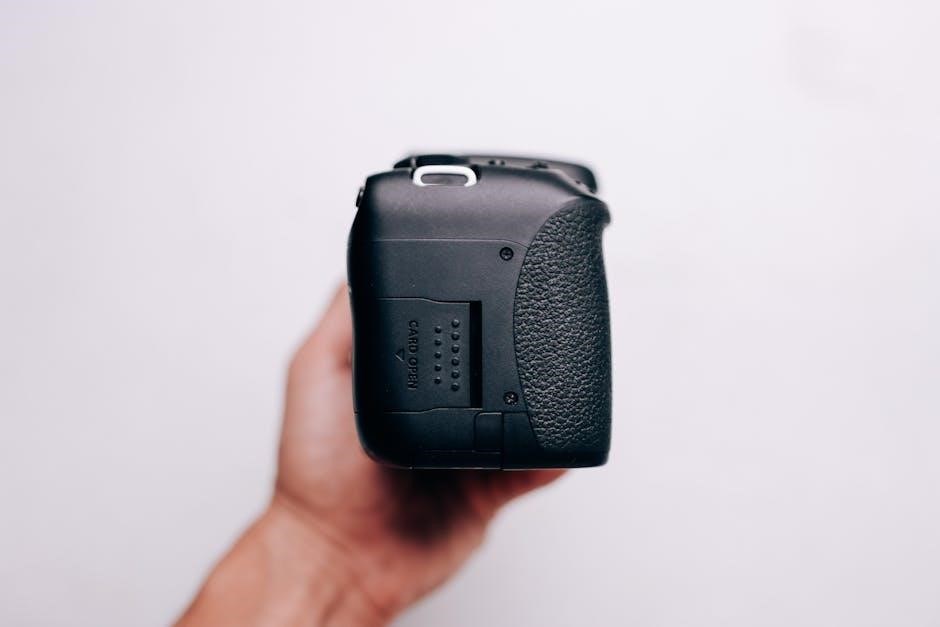
The Canon Rebel XT manual provides explicit instructions for battery and memory card insertion. It details the battery compartment location and proper battery orientation, emphasizing correct polarity. The manual highlights the importance of using compatible memory card types. Step-by-step diagrams illustrate how to securely insert the card until it clicks into place. Users are cautioned against forcing the card or battery. Proper insertion ensures reliable power and data storage, crucial for capturing and saving images without interruption or data loss.
Powering On and Basic Camera Controls
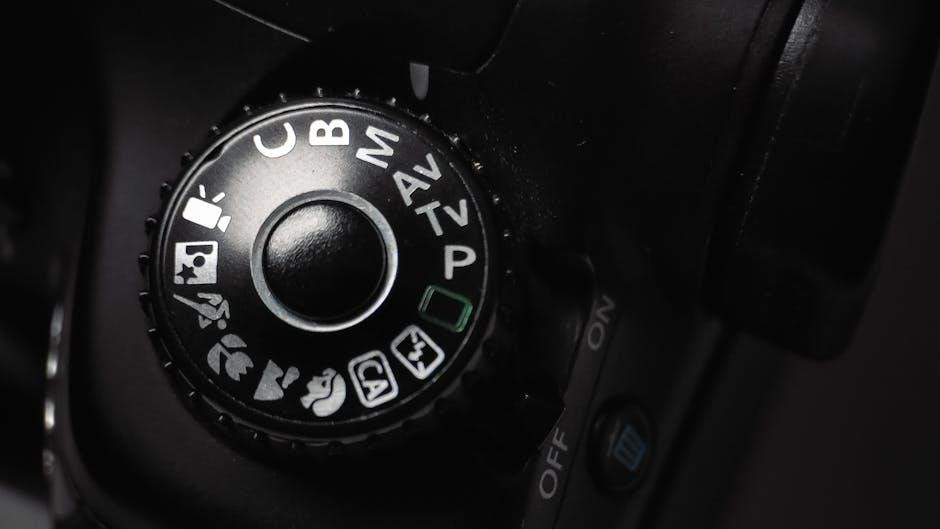
The Canon Rebel XT manual clearly explains the power switch location and operation. It details the function of the shutter button for taking pictures and the importance of half-pressing for autofocus. The manual illustrates the mode dial, explaining each shooting mode’s purpose. It also covers the control dial for adjusting settings like aperture and shutter speed. Understanding these basic controls, as outlined in the manual, is fundamental for beginners to start capturing images and exploring the camera’s capabilities.

Understanding the Shooting Modes
The Canon Rebel XT manual details various shooting modes, from fully automatic options for beginners to advanced manual controls for experienced photographers.
Auto Mode for Beginners
For newcomers to DSLR photography, the Canon Rebel XT’s Auto mode simplifies image capture. The camera automatically selects optimal settings for exposure, focus, and white balance, requiring minimal user input.
The manual emphasizes this mode’s convenience, allowing photographers to concentrate on composition and capturing the moment. It’s ideal for everyday snapshots and situations where quick results are prioritized over precise control.
However, the manual also notes that relying solely on Auto mode limits creative exploration and understanding of photographic principles. It’s a great starting point, but encourages users to eventually explore semi-automatic and manual modes.
Program Mode (P) ⎯ Semi-Automatic Control
Program (P) mode on the Canon Rebel XT offers a balance between automatic convenience and manual control. The camera sets both aperture and shutter speed, but allows the user to adjust ISO, white balance, and exposure compensation.
The manual highlights this mode as a step up from full Auto, providing more creative flexibility without overwhelming beginners. Users can influence the image’s overall brightness using exposure compensation, while the camera handles technical settings.
It’s suitable for varied shooting conditions where precise control isn’t essential, yet a degree of customization is desired.
Shutter Priority Mode (Tv) ⎯ Controlling Motion
Shutter Priority (Tv) mode on the Canon Rebel XT empowers photographers to dictate the shutter speed, directly influencing motion depiction. The camera automatically adjusts the aperture to achieve proper exposure. Canon’s manual explains this is ideal for freezing fast action – using a quick shutter speed – or blurring movement, like flowing water, with a slower one.
Understanding the interplay between shutter speed and aperture is key. This mode offers creative control over how motion is rendered within the final image, providing dynamic results.
Aperture Priority Mode (Av) ⎯ Controlling Depth of Field
Aperture Priority (Av) mode on the Canon Rebel XT allows photographers to control the lens aperture, influencing the depth of field. The camera automatically selects the appropriate shutter speed for correct exposure. Canon’s manual details how wider apertures (lower f-numbers) create shallow depth of field, ideal for portraits, while narrower apertures (higher f-numbers) yield greater depth of field, suited for landscapes. Mastering aperture control is crucial for artistic image creation, focusing attention and blurring backgrounds effectively.
Manual Mode (M) ⏤ Full Control
Manual (M) mode on the Canon Rebel XT grants photographers complete control over both aperture and shutter speed. The camera’s manual explains this mode requires understanding the exposure triangle – aperture, shutter speed, and ISO. It’s ideal for challenging lighting situations or when precise creative control is desired. Users independently set each parameter, monitoring the light meter for proper exposure. Mastering manual mode unlocks full photographic potential, allowing for unique artistic expression and overcoming automatic limitations.
Focusing and Image Quality
The Canon Rebel XT manual details autofocus modes and image quality settings like RAW versus JPEG. Understanding these options is crucial for achieving desired sharpness and detail.
Autofocus Modes and Selection
The Canon Rebel XT manual comprehensively explains the camera’s autofocus (AF) system. It details various AF modes, including One-Shot for stationary subjects and AI Servo for tracking moving objects. Users learn to select appropriate AF points, influencing focus precision.
The manual clarifies how to switch between AF modes using the AF mode selector on the camera body. It also covers focusing areas – single point, multiple point, and automatic selection – allowing photographers to tailor focus to specific scenes. Understanding these settings is vital for consistently sharp images, as detailed within the guide.
Understanding Image Quality Settings (RAW vs. JPEG)
The Canon Rebel XT manual dedicates a section to image quality settings, specifically contrasting RAW and JPEG formats; It explains that JPEG files are compressed, resulting in smaller file sizes but some data loss. Conversely, RAW files retain all image data captured by the sensor, offering greater flexibility in post-processing.
The manual guides users on selecting the appropriate format based on their needs. RAW is recommended for serious editing, while JPEG is suitable for quick sharing or when storage space is limited. Understanding these differences, as outlined in the guide, empowers informed shooting decisions.
ISO Settings and Noise Reduction
The Canon Rebel XT manual details the camera’s ISO settings, explaining how they affect image brightness and noise levels. Lower ISO values (e;g., 100) produce cleaner images in bright light, while higher ISOs (e.g., 1600) are useful in low-light situations but introduce more digital noise.
The manual also covers the camera’s noise reduction features, which can help minimize the appearance of noise at higher ISOs. It advises users to experiment with different ISO settings and noise reduction levels to find the optimal balance between image quality and brightness.
Navigating the Menu System
The Canon Rebel XT manual guides users through its menu system for customizing settings. It details options for image quality, autofocus, and various camera functions.
Customizing Camera Settings
The Canon Rebel XT manual extensively covers customizing settings to personalize your shooting experience. Users can adjust image quality, selecting between RAW and JPEG formats for flexibility in post-processing. Autofocus settings allow tailoring to specific subjects and shooting scenarios, optimizing sharpness.
Date, time, and copyright information can be set within the menu, protecting your work. Further customization includes white balance, picture styles, and various operational preferences. The manual provides step-by-step instructions, ensuring users can fully leverage the camera’s capabilities and achieve desired results.
Setting Date, Time, and Copyright Information
The Canon Rebel XT manual details how to accurately set the date and time within the camera’s menu system. This ensures correct timestamps on your images, crucial for organization and chronological order. Importantly, the manual guides users through inputting copyright information directly into the camera.
This embeds your authorship details into the image metadata, offering a layer of protection and identification. Properly configured, this information travels with the image file, safeguarding your intellectual property. The manual provides clear, concise instructions for this vital process.
Using the Built-in Flash
The Canon Rebel XT manual explains various flash modes, including auto, red-eye reduction, and forced flash. It also details compatibility with external flash units for enhanced photography.
Flash Modes and Red-Eye Reduction
The Canon Rebel XT manual details several built-in flash modes. Auto mode lets the camera decide when to fire the flash, while forced flash activates it regardless of light. Red-eye reduction attempts to minimize the red-eye effect by emitting pre-flashes before the main flash.
Understanding these modes, as outlined in the manual, is crucial for achieving well-lit and natural-looking photos. The manual also provides guidance on optimizing flash settings for different shooting scenarios, ensuring users can effectively utilize the built-in flash for various photographic needs.
External Flash Compatibility
The Canon Rebel XT manual confirms compatibility with Canon’s EX-series Speedlites. Utilizing an external flash offers greater power and control over lighting compared to the built-in flash. The manual details how to attach and configure these external units, including settings for high-speed sync and E-TTL metering.
Users can explore advanced flash techniques, enhancing creative possibilities. The manual guides photographers through utilizing off-camera flash setups, providing detailed instructions for optimal results and expanding beyond the camera’s integrated flash capabilities.
Reviewing and Deleting Images
The Canon Rebel XT manual explains playback mode for image review, including zoom functionality. It also details how to efficiently delete unwanted images from the memory card.
Playback Mode and Zoom Function
The Canon Rebel XT manual details accessing playback mode to review captured images directly on the camera’s LCD screen. Users can navigate through photos using the directional buttons, ensuring easy browsing of their photographic work. A crucial feature is the zoom function, allowing for detailed inspection of image sharpness and composition.
The manual clarifies how to zoom in and out, enabling precise evaluation of focus and potential flaws. This functionality is invaluable for confirming image quality before transferring them to a computer or sharing them. Understanding these controls, as outlined in the manual, is key to effective image assessment.
Deleting Images from the Memory Card
The Canon Rebel XT manual provides clear instructions on deleting unwanted images from the memory card, freeing up space for new photos. Users can delete images individually or utilize batch deletion to remove multiple files at once, streamlining the process. The manual emphasizes caution, warning that deleted images are often unrecoverable.
It details the confirmation prompts designed to prevent accidental deletion of cherished photos. Understanding the deletion process, as explained in the manual, is vital for efficient memory card management. Always double-check selections before confirming deletion to avoid irreversible data loss.
Connecting to a Computer
The Canon Rebel XT manual details image transfer via USB or a card reader. These methods allow users to easily download photos to their computers for editing and storage.
Transferring Images via USB
According to the Canon Rebel XT manual, connecting your camera to a computer via USB is a straightforward process. First, ensure your computer recognizes the camera when connected. You may need to install Canon’s drivers, often automatically installed by the operating system.
Once connected, the camera typically appears as a removable drive. You can then browse the DCIM folder on the camera’s memory card to copy your images. Alternatively, utilize Canon’s bundled software, ZoomBrowser EX, for organized image transfer and basic editing capabilities. Remember to safely eject the camera after transferring files to prevent data corruption.
Using a Card Reader
The Canon Rebel XT manual details that a card reader offers a faster alternative to USB transfer. Simply insert your camera’s CompactFlash (CF) card into the card reader, connected to your computer. The card will appear as a removable drive, allowing direct access to your images.
This method bypasses the camera’s internal USB connection, often resulting in significantly quicker transfer speeds. It’s particularly useful for large batches of photos or video. Ensure the card reader is compatible with CF cards for optimal performance and reliable data transfer.
Troubleshooting Common Issues
The Canon Rebel XT manual addresses issues like the camera failing to power on or displaying error messages, offering solutions for quick fixes and continued use.
Camera Not Turning On
If your Canon Rebel XT fails to power on, the manual suggests checking the battery first. Ensure it’s properly inserted and fully charged, or try a known working battery.
Verify the battery contacts within the camera aren’t dirty or damaged; clean them gently if needed. Also, confirm the power mode dial isn’t set to ‘OFF’.
If these steps don’t resolve the issue, consult the manual’s troubleshooting section for further guidance, potentially indicating a more significant hardware problem requiring professional attention.
Error Messages and Solutions
The Canon Rebel XT’s manual details various error messages, each indicating a specific problem. “Err 99” often signals a shutter curtain issue, potentially needing repair. Card errors (like “Card Full” or “No Card”) require checking the memory card’s capacity or proper insertion.
Lens communication errors suggest compatibility or connection problems. The manual provides specific steps for each error, often involving restarting the camera or re-seating components. If errors persist, professional servicing is recommended.

Resources and Further Learning
Canon’s official website offers support, while numerous third-party tutorials and guides, alongside the camera’s manual, enhance your Rebel XT experience.
Canon’s Official Support Website
Canon provides a comprehensive support network for the Rebel XT (350D) through its official website. Users can access downloadable manuals, including the original camera instruction manual, offering detailed guidance on all features and functions.
The website also features a frequently asked questions (FAQ) section addressing common issues and troubleshooting steps. Furthermore, Canon’s support portal offers driver and software updates to ensure optimal camera performance and compatibility with modern operating systems.
Direct access to Canon’s resources ensures users receive accurate and up-to-date information directly from the manufacturer, aiding in maximizing the Rebel XT’s capabilities.
Third-Party Tutorials and Guides
Beyond Canon’s official resources, a wealth of third-party tutorials and guides exist for the Rebel XT. Websites and platforms like YouTube host numerous video tutorials covering everything from basic operation to advanced photography techniques.
Books, such as “Canon EOS Digital Rebel XT Guide to Digital SLR Photography” by David D. Busch, offer in-depth explanations and practical advice. The Internet Archive provides access to scanned copies of the original user manual, offering a convenient digital resource.
These external resources often present information in diverse formats, catering to various learning styles and skill levels.